Why 6-inch seamless is our standard here
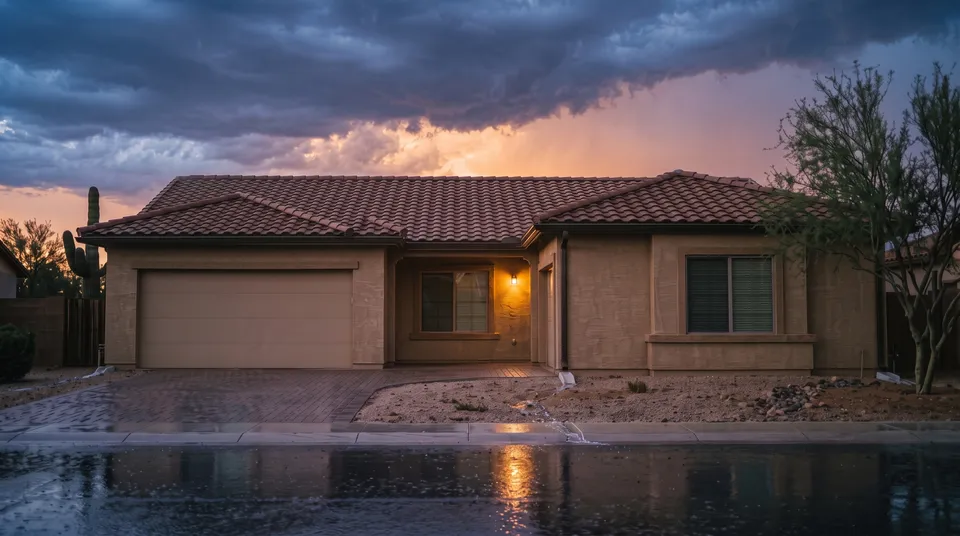
Phoenix gets very little rain in a year, and most of it arrives in a handful of monsoon storms between mid-June and the end of September. A single strong cell can put down an inch of rain in under an hour. One inch on a 2,000 square foot roof is about 1,246 gallons, and every gallon of it reaches the eave inside the same short window. A 5-inch trough is built for steady rain spread across a day. It fills, then sheets over the front lip right where the roof valleys concentrate the flow. A 6-inch trough holds more water and pairs with a larger outlet, so the run keeps draining instead of overflowing at the corners. That extra capacity is the whole reason we standardized on it. Every run is formed in your driveway. The roll-forming machine rides on our trailer, takes a coil of painted aluminum, and turns out one continuous piece cut to the exact length of the eave. No seams along the run means no seams to dry out and leak. The only joints are at corners, end caps, and outlets, and those are sealed and riveted. Coil comes in dark gray, bronze, white, and tan, which covers nearly every stucco and trim color in the Valley and most HOA palettes.
How gutters attach to a tile roof
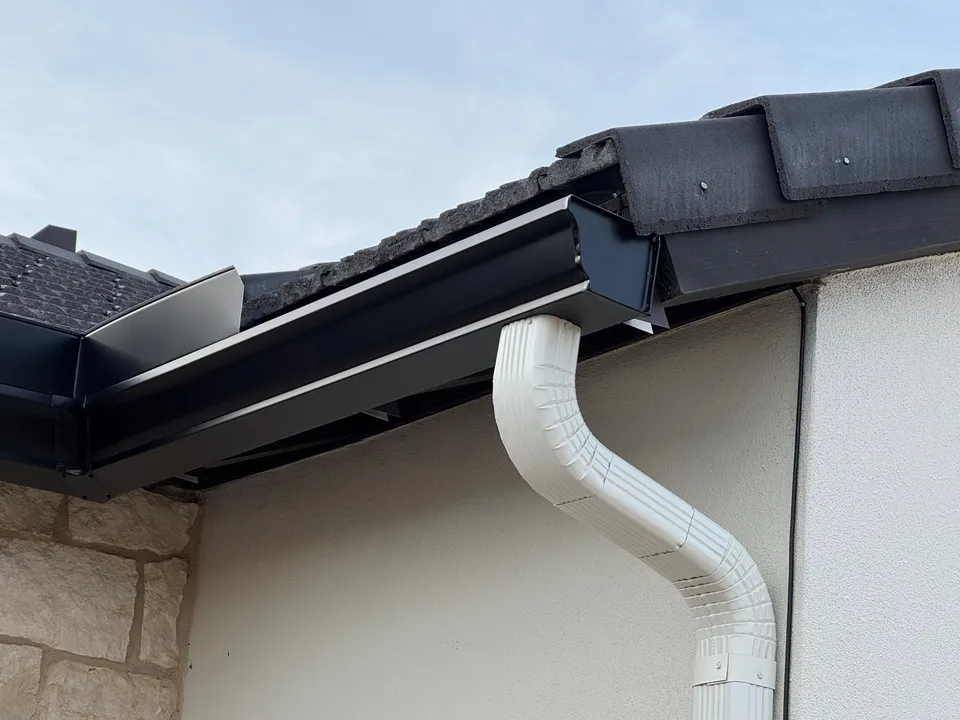
Most homes in our service area have concrete S-tile or flat tile roofs, and that changes how a gutter goes on. The tile overhangs the eave, and the underlayment beneath it is the real waterproof layer, so the gutter has to catch water coming off both the tile and the drip edge. We hang the trough on the fascia with hidden hangers screwed into solid wood rather than spikes driven through the face, so daily heat cycling cannot walk the fasteners out. The back of the gutter tucks under the existing drip edge, or we add one, so water leaving the underlayment lands in the trough instead of running down the fascia behind it. On S-tile eaves the height matters: too high and the tile nose splashes over the front lip, too low and the trough misses the sheet coming off the valleys. Bird stops at the eave stay in place and the first course of tile is never lifted. Shingle and foam roofs are simpler, and we handle those the same day.
Downspouts: how many, what size, and where the water goes
The gutter only collects. The downspout is what gets the water away from the house, and it is the part most installers undersize. We use 2x3 downspouts on short runs and small roof sections, and 3x4 on long runs, anything fed by a valley, and most 6-inch systems. The 3x4 has twice the opening of a 2x3, and it clears palo verde litter and roof grit that would plug a smaller elbow. Placement follows the roof, not the wall: an outlet at every low corner, and one wherever two roof planes dump into the same stretch of eave. At grade, each downspout ends in a splash block or a buried extension that carries water four to six feet out from the slab, past the foundation and the paver edge. Dumping a full downspout at the wall is worse than having no gutter at all, because it concentrates a whole roof section in one spot on soil that does not absorb quickly.
What gutter installation costs in Phoenix
Seamless gutter installation in Phoenix runs $16 to $25 per linear foot installed. That covers the trough, hangers, corners, end caps, and labor. The number lands at the low end on a simple single-story shingle roof with straight runs, and at the high end on a two-story tile roof with a lot of corners. We measure the eave and give you a written price by the foot before any work starts. What moves it:
- Linear feet. More eave means more coil, more hangers, and more time on the ladder.
- Corners and miters. Every inside or outside corner is hand-cut and sealed. A house with a lot of jogs takes longer than a rectangle.
- Downspout count and size. Each drop adds material and labor, and 3x4 costs more than 2x3.
- 6-inch versus 5-inch. We recommend 6-inch here. It uses more coil and larger outlets.
- Color. Dark gray, bronze, white, and tan are our stock colors. Ask if you need a match outside those.
- Roof height. Second-story eaves mean taller ladders, more setup, and slower work.
- Tile versus shingle. Tile eaves take more care to set the height and the drip edge correctly.
- Tearing off old gutters. Removing and hauling away a failed sectional system adds a line to the estimate.
When we would talk you out of gutters
Not every house needs a full perimeter, and we would rather say so at the estimate than sell you 200 feet you do not need.
- Deep eaves over gravel that slopes away from the slab, no staining on the stucco, and no patio or walkway below: you are fine for now. Watch it through one monsoon and call if something changes.
- One trouble spot, usually a valley dumping on the entry or a patio: a 15 or 20 foot section with one downspout solves it. You do not need the whole house done.
- Existing 5-inch gutters that only overflow at one corner: that is usually a missing outlet or a clogged downspout. Start with a repair visit, not a replacement.
What you get
- 6-inch seamless aluminum as the standard, sized for monsoon flow rather than steady rain
- Formed on site in one continuous piece per run, so the only joints are at corners and outlets
- Hidden hangers screwed into solid wood, not face spikes that heat cycling works loose
- Downspouts sized and placed by roof section, with extensions that carry water away from the slab
- Four stock colors (dark gray, bronze, white, tan) that match Valley stucco and HOA palettes
- Locally owned, AZ ROC 336896 (CR-42), bonded and insured, most homes finished in a day
How it goes
- 01
Free estimate at the house
We walk the roofline, measure every eave, count the corners and outlets, check the fascia, and hand you a written price by the foot.
- 02
Form the gutters in your driveway
The machine runs each length off the coil in your chosen color, cut to the eave. Nothing is spliced.
- 03
Hang, pitch, and seal
Hidden hangers into solid wood, a slight fall toward each outlet, corners and end caps sealed and riveted.
- 04
Downspouts, extensions, water test
Drops go in at every low point, extensions carry water clear of the slab, and we run a hose before we leave. Old gutters and scrap go with us.
Google reviews
From the Google reviews
-
“Blueberry did a fantastic job on my place in North Phoenix, if you need rain gutters give them a call!”
Andrew S. · Google review
-
“Grant did a great job and a good price. Went above and beyond what we hoped for. It’s unusual for me to refer a contractor and I will definitely refer Blueberry.”
Scott N. · Google review
Questions we get asked
How much should it cost to install gutters in Phoenix?
Seamless aluminum gutters installed in Phoenix run $16 to $25 per linear foot, including hangers, corners, and labor. A single-story shingle roof with straight runs sits at the low end. Two-story tile roofs with many corners and 3x4 downspouts sit at the top. We measure and give a written number before any work starts.
How much are gutters on a 2,000 square foot house?
It depends on the eave length, not the floor area. A 2,000 square foot single-story home usually has somewhere between 150 and 200 feet of eave, though a courtyard plan or a lot of jogs changes that fast. Multiply the measured footage by $16 to $25 per foot, then add downspouts. We measure for free.
Why do new builds in Arizona not have gutters?
Builders leave them off because Arizona code does not require them on most homes and skipping them saves money on every lot. The house passes inspection without them. The cost shows up later as stained stucco, trenched gravel, and pooling at the slab after the first monsoon season, which is usually when homeowners call. Why your house came without gutters has the longer story.
Are seamless gutters worth the extra cost over sectional?
Yes, in this climate. Sectional gutters have a sealed joint every ten feet, and Phoenix sun hardens that sealant until it cracks. Seamless runs are one piece from corner to corner, so the only joints are at the ends and outlets. Less sealant means fewer leaks and fewer streaks on the stucco under each seam.
Do I need gutters in Arizona if it barely rains?
Most homes do. The annual total is small. The problem is that a monsoon cell drops an inch of rain in under an hour onto soil that does not absorb it. One inch on a 2,000 square foot roof is about 1,246 gallons landing at the foundation. Gutters and extensions put that water where it does no harm.
Related
Where we do this work
Gutter Installation across Phoenix and the North Valley: North Phoenix, Cave Creek, Scottsdale, Anthem, New River, Glendale, Desert Hills, Peoria, Surprise, Deer Valley, Mesa, Gilbert, and the neighborhoods between them. See the full service area.