Scuppers, collector boxes, and box gutters
A scupper is the opening through the parapet wall that lets water off the roof. Most feed a sheet-metal collector box on the exterior wall, which feeds a downspout to grade or into a drain line. Some buildings run a box gutter along a low edge instead, a wide rectangular trough that collects from the whole slope and drops to several downspouts. Each joint in that path is a place things go wrong: debris packed in the scupper throat, a collector box full of gravel and silt that never fully drains and rusts from the inside, failed sealant where the scupper sleeve meets the membrane, seams on the box that leak down the wall instead of into the downspout, and a downspout crushed at grade or discharging right against the slab. We clear all of it, flow-test each outlet, reseal sleeves and seams, and replace collector boxes and downspout sections that are past repair.
Why flat roofs collect so much debris in the Valley
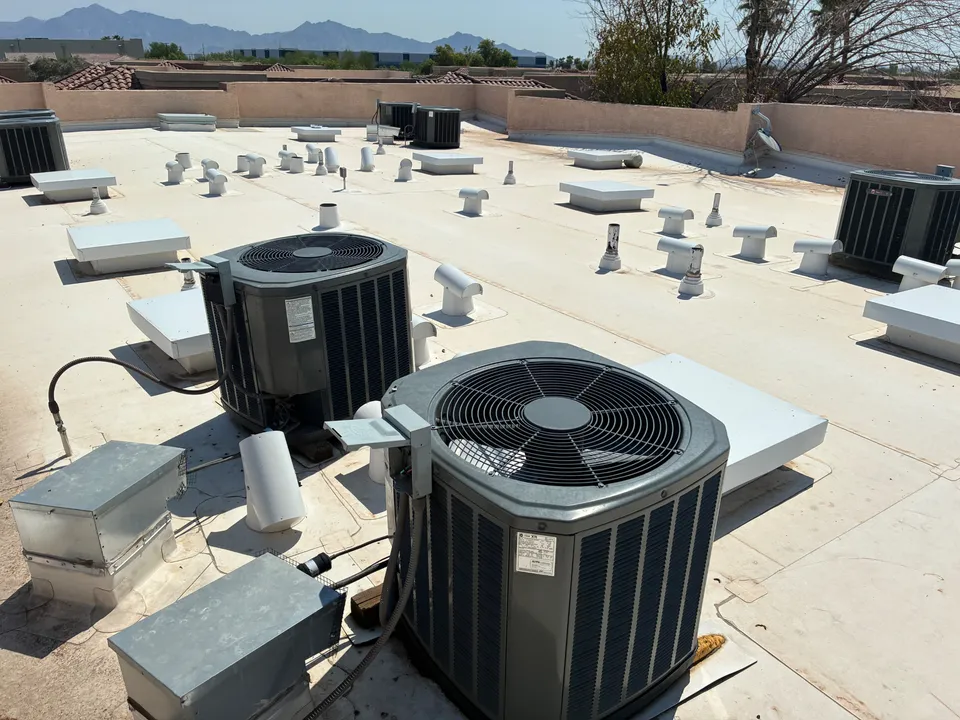
A pitched roof sheds what lands on it. A flat roof keeps it. Dust arrives on every windy afternoon and in every haboob and settles across the membrane. Rooftop HVAC units create eddies that push it into corners, which is exactly where the scuppers are. Add roof gravel that has migrated, palm fronds, seed pods from nearby trees, and packaging that blew up from the loading dock, and after a season or two there is a compacted mat around every outlet. On a dry day it looks harmless. In the first monsoon burst it becomes a dam, water ponds behind it, and ponded water is both a load on the structure and a reservoir looking for any seam. Water weighs a little over five pounds per square foot for every inch of depth, so two inches across a large roof section is a serious amount of weight. Ponding also shortens membrane life under Phoenix sun and heat cycling. Ponding on an otherwise sound roof almost always traces back to a blocked outlet.
An inspection cadence that matches the monsoon
Two scheduled visits handle most buildings, with extras for properties that produce more debris.
- Late May or early June, before June 15: clear every scupper, collector box, box gutter, drain strainer, and downspout, then flow-test each outlet with a hose.
- October, after September 30: remove storm debris and silt, re-inspect sealant and seams, photograph anything that moved.
- Quarterly on buildings with mature trees, palms, heavy dust exposure, or frequent rooftop HVAC traffic.
- After any major storm: a quick check of outlets, the walls below the scuppers, and ground-level discharge points.
- Once a year: confirm downspouts still discharge away from the slab, entries, and walkways.
What the work covers
Our work is drainage. That means clearing and flow-testing outlets, resealing scupper sleeves and box seams, fabricating and replacing rusted collector boxes, adding an overflow scupper where a blocked primary would flood the deck, upsizing box gutters and downspouts on runs that overflow every storm, and rerouting discharge away from entries and foundations. Membrane, tile, and deck repairs are a separate scope. If we see a problem there while we are up, we photograph it and tell you, so it can be dealt with before it becomes a leak. All of our work happens on the roof and the exterior, scheduled around your hours, so tenants and customers are not disturbed.
What you get
- Every scupper, collector box, box gutter, and downspout cleared and flow-tested, not only the visible ones
- Scupper sleeves and box seams resealed, rusted collector boxes fabricated and replaced
- Overflow scuppers and upsized outlets where a blocked primary would flood the deck
- Discharge rerouted away from entries, walkways, and the slab
- Dated photo record of each outlet before and after, for your maintenance file
- Work from the roof and the exterior, scheduled around business hours
How it goes
- 01
Roof walk and outlet count
We map every drain, scupper, box, and downspout, photograph their condition, and note what is blocked, rusted, or undersized.
- 02
Written scope by outlet
Clearing, resealing, and any replacement are listed outlet by outlet so you can approve exactly what gets done.
- 03
Clear, repair, flow-test
Each outlet is cleared to grade, repairs are made, and every one is tested with a hose before we come down.
- 04
Report and schedule the next visit
You get the photo set and a recommended date for the next visit based on what the roof produced.
Google reviews
From the Google reviews
-
“Highly recommend Grant and his team at Blueberry Gutters for all your gutter work. They are very knowledgeable, do great work, and communicate very well throughout the project! Thank you!”
Teemu R. · Google review
-
“Blueberry did a fantastic job on my place in North Phoenix, if you need rain gutters give them a call!”
Andrew S. · Google review
Questions we get asked
How often should commercial roof drains and scuppers be cleaned in Phoenix?
At least twice a year: once before monsoon season starts on June 15 and once after it ends on September 30. Buildings with mature trees, palms, heavy dust, or a lot of rooftop HVAC traffic usually need a quarterly visit, and every building benefits from a quick check after a major storm.
What is a scupper and why does it clog?
A scupper is an opening cut through the parapet wall that lets water leave a flat roof, usually into a collector box and downspout on the outside. It clogs because it sits at the low corner where wind and HVAC airflow push dust, gravel, and debris, and nothing rinses that corner for months at a time.
Why does water pond on my flat roof after a storm?
Usually because an outlet is blocked. The membrane may be fine while the scupper throat, the drain strainer, or the collector box is packed with silt and debris, so water backs up behind it. Ponded water adds weight to the structure and shortens membrane life, and it finds any seam. Clearing the outlet fixes most cases.
Can you service an occupied building without disrupting tenants?
Yes. Everything happens on the roof and the exterior wall, and we schedule around your hours for retail, medical, and multifamily properties. No interior access is needed unless a downspout ties into an interior drain line, and we tell you ahead of time if it does.
Do you install new gutters on commercial buildings?
Yes, where a building has an eave or a low edge that needs a box gutter or a 6-inch seamless run, and we upsize downspouts and add scuppers on existing systems. Our scope stays with drainage: getting water off the roof and away from the building, not the roof itself.
Related
Where we do this work
Commercial Gutters across Phoenix and the North Valley: North Phoenix, Cave Creek, Scottsdale, Anthem, New River, Glendale, Desert Hills, Peoria, Surprise, Deer Valley, Mesa, Gilbert, and the neighborhoods between them. See the full service area.