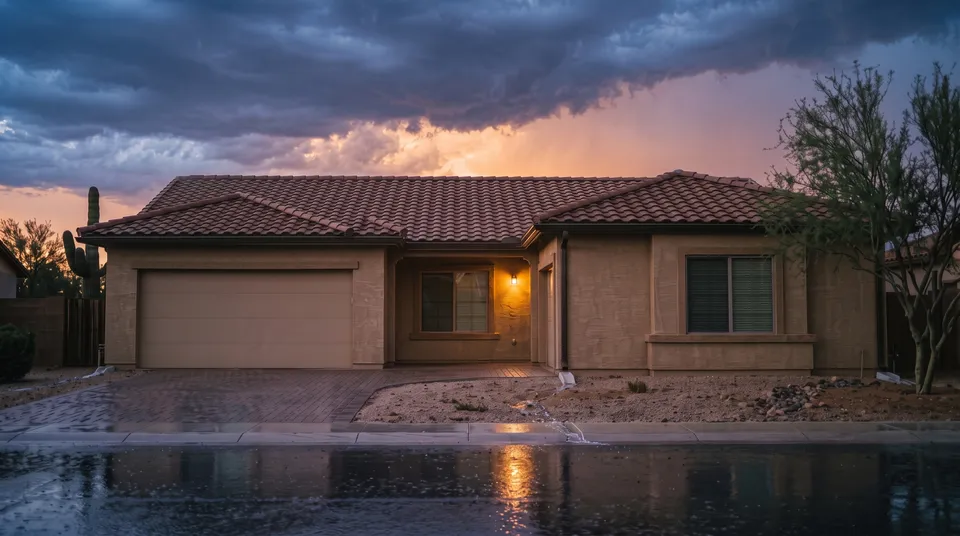

What clogs a Phoenix gutter
Desert debris is small and heavy. Palo verde drops tiny yellow flowers by the bucket each spring, then seed pods. Mesquite drops bean pods and fine leaflets that break down into a paste. Ironwood and acacia shed similar litter, and jacaranda adds sticky blossoms in some neighborhoods. Underneath all of it is dust, blown in on every windy afternoon and every haboob and settling in the trough where nothing rinses it out for months. Add roof grit from a foam or shingle roof and you get a sediment bed that turns to mud in the first monsoon storm and sets like plaster afterward. That mix goes straight through a wide screen and gets stuck inside a foam insert. A guard that works here has to stop fine material, not leaves.
Micro-mesh, perforated, or foam: which survives a monsoon
We recommend fine micro-mesh and recommend against foam. The reasons are specific to this debris.
- Micro-mesh: a fine stainless mesh over an aluminum frame, screwed to the front lip of the gutter and tucked under the drip edge. Palo verde flowers, pods, and grit stay on top where the sun dries them and the wind clears them, and water passes through even at monsoon rates. This is what we install.
- Perforated aluminum: punched holes in a solid sheet. Fine for pods and larger litter, but palo verde flowers and grit pass through the holes and the trough still needs cleaning, only now under a cover.
- Foam inserts: a wedge of open-cell foam pushed into the trough. Dust and roof grit fill the pores within a season, the foam holds water against the gutter, and there is no way to clean it. We would rather pull these out than put them in.
- Coarse screens and snap-in plastic: cheap, and they let everything that matters here straight through. They also lift in monsoon wind and turn brittle in the sun.
Guards on a tile roof
A concrete tile eave is where guard installs go wrong most often. The tile overhangs the gutter, so a guard has to sit under the tile nose without lifting the first course or blocking the bird stops. We fasten micro-mesh to the front lip of the gutter and slide the back edge under the drip edge or against the eave metal, leaving the tile untouched. On S-tile, the guard follows the gutter rather than the wave of the tile, so there is a small gap under each high point. That gap is where roof water enters, and it is too small for pods. Foam and snap-in products cannot be made to fit a tile eave correctly, which is one more reason we skip them.
When gutter guards are not worth it
Guards cost real money on top of the gutters, and on some houses they buy nothing.
- No trees within about thirty feet of the roof and a tile roof that sheds no grit: your gutters need a rinse before monsoon and that is all. Spend the money on downspout extensions instead.
- A 5-inch sectional gutter that already sags or leaks: guards on a failing system trap the problem under a lid. Repair or replace first, then talk about guards.
- A single-story home you are comfortable checking from a ladder twice a year: guards save you that chore, and only that chore. If you do not mind it, skip them.
What you get
- Guard styles chosen for palo verde bloom, mesquite pods, ironwood litter, and dust, not for leaves
- Fine micro-mesh that stops roof grit and blossom while passing monsoon-rate water
- Fitted under the tile nose on S-tile and flat-tile eaves without disturbing the first course
- Fastened to the gutter lip and drip edge so monsoon wind cannot lift the panels
- Installed on new 6-inch seamless gutters or on sound existing gutters after a full cleaning
- An honest no when the trees, the roof, or the existing gutters mean guards would not help
How it goes
- 01
Check what lands on the roof
We look at the trees around the house, the roof material, and what is already in the trough. That tells us if guards will help.
- 02
Clean and inspect the gutters
Guards go on clean, pitched, solid gutters only. Sediment gets flushed and any hanger or seal problem is fixed first.
- 03
Fit the mesh to the eave
Panels are cut to length, fastened to the front lip, and set under the drip edge or tile nose without lifting tile.
- 04
Water test
We run a hose over the roof edge to confirm water goes through the mesh and out the downspouts, then leave you the care notes.
Google reviews
From the Google reviews
-
“Highly recommend Grant and his team at Blueberry Gutters for all your gutter work. They are very knowledgeable, do great work, and communicate very well throughout the project! Thank you!”
Teemu R. · Google review
-
“Blueberry Gutters helped me choose the perfect solution for my home. Then delivered everything on time. Top rate service!”
Joel P. · Google review
Questions we get asked
What is the downside to gutter guards?
Cost, and false confidence. Guards do not make a gutter maintenance-free. Fine dust still settles through mesh over a year, and blossoms sit on top until wind clears them. The wrong style makes things worse: foam holds mud, coarse screens let pods in. Plan on a rinse and a look each spring even with guards.
Are gutter guards worth it in Arizona with so few leaves?
Only if you have trees. Palo verde, mesquite, ironwood, and acacia drop flowers and pods that plug downspouts fast, and a guard that stops fine debris keeps you off the ladder before monsoon. With no trees near the roof, a yearly rinse does the same job for less. We tell you which case you are at the estimate.
What is the average cost of having gutter guards installed in Phoenix?
Guards are priced per linear foot on top of the gutter, and the total depends on footage, guard style, roof height, and the type of eave. Micro-mesh costs more than screen and lasts far longer in this sun. We quote guards as a separate line on the estimate so you can decide run by run.
What is the best gutter guard for Phoenix?
For desert debris, a fine stainless micro-mesh on an aluminum frame. It stops palo verde flowers, mesquite pods, and roof grit while passing water at monsoon rates, and it fits under a tile eave. We do not rank brands. The mesh size and how the panel is fastened matter far more than the name on the box.
Which gutter guards are the worst?
Foam inserts and snap-in plastic screens, in this climate. Foam fills with dust and grit within a season, holds water against the gutter, and cannot be cleaned. Plastic screens turn brittle in the sun and lift in monsoon wind. Both usually end up in our trailer when we replace a system.
Related
Where we do this work
Gutter Guards across Phoenix and the North Valley: North Phoenix, Cave Creek, Scottsdale, Anthem, New River, Glendale, Desert Hills, Peoria, Surprise, Deer Valley, Mesa, Gilbert, and the neighborhoods between them. See the full service area.