Acre lots on the old Sam Joy Ranch
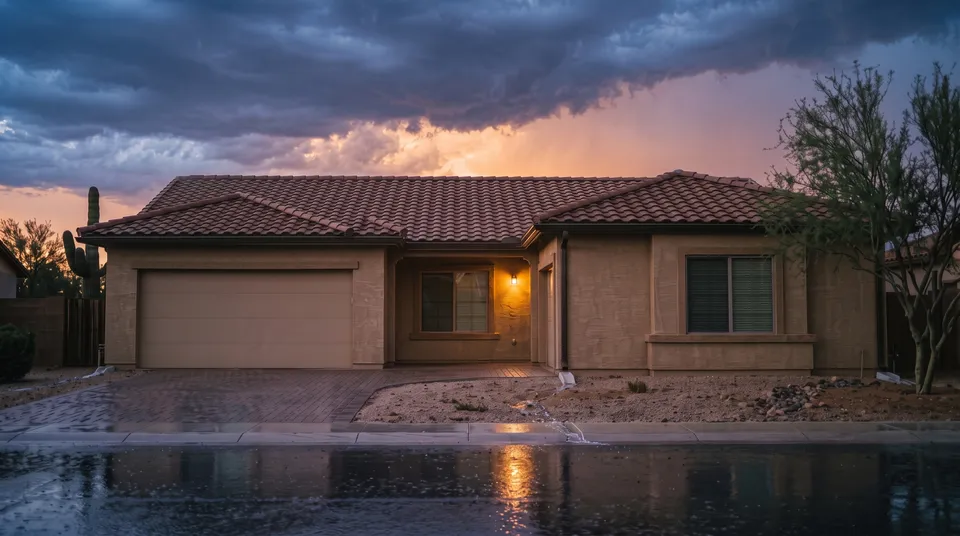
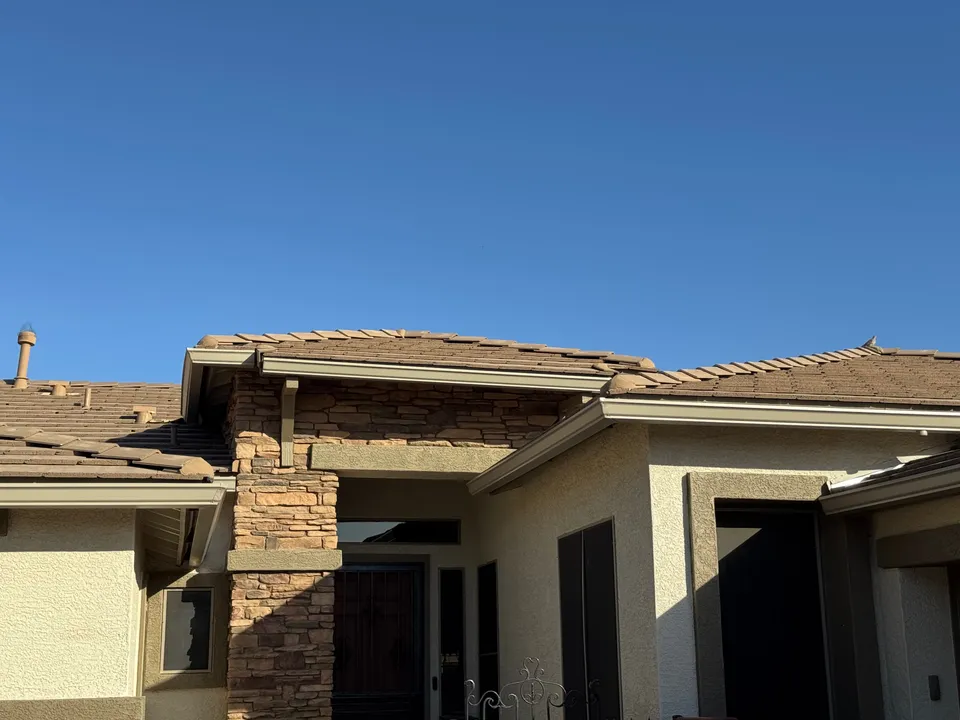
Desert Hills started in 1955, when a land company bought about 4,280 acres of the Sam Joy Ranch, then sixteen miles north of the Phoenix city limit, and cut it into ten-acre parcels. Those have been split over the decades, but the pattern held: large-lot, low-density custom homes on one acre and up, the kind of place people buy for horses, a shop, an RV gate and distance from the neighbors. Joy Ranch Road still carries the name. Most of the housing is custom or semi-custom from the 1980s through the 2010s, single story, stucco over frame or block, with a tile roof on the newer builds and metal or flat roofs on many of the outbuildings. A lot of Desert Hills runs on a private or shared well and a septic system rather than city water and sewer. Almost none of it was built with gutters, and the first monsoon shows why: roof water cutting channels through the gravel and pooling against the slab.
Hardpan, sheet flow and the leach field
The ground under Desert Hills is the same caliche and decomposed granite that runs from Cave Creek across to New River, and it moves water the same way: sideways. Rain lands, refuses to soak in, and runs across the lot toward the nearest wash. On a flat pad that was graded for the house, the low line often runs along the foundation, and a roof valley dumping a few hundred gallons in ten minutes will find it. The Desert Hills complication is the septic field. A downspout discharging onto or uphill of a leach field can saturate it, and a saturated field backs up. So the first thing we do on a Desert Hills estimate is walk the lot, find the tank and the field, find the natural low line, and plan the downspout discharge to the downhill side of the property away from both. Gutters here are as much about where the water goes as about keeping it off the stucco.
Monsoon at the edge of the foothills
Desert Hills sits where the Valley floor starts to rise toward Daisy Mountain and the Cave Creek country, and it shares the foothill monsoon pattern: cells build to the north and east in the afternoon and drop their heaviest rain on Cave Creek, Anthem, New River and Desert Hills before they drift south. Monsoon season runs June 15 to September 30. An inch or more out here while Phoenix records a quarter inch is a normal storm report. One inch on a 2,000 square foot roof is about 1,246 gallons, and a Desert Hills house with a shop and a covered horse stall is often twice that. Metal roofs shed it almost instantly. That volume, arriving in twenty minutes, is why we spec 6-inch seamless gutters with 3x4 downspouts as the standard out here, and why we do not recommend the smaller gutters that show up in store-bought kits.
Seamless gutter installation in Desert Hills
Desert Hills is the kind of place the on-site gutter machine was built for. We roll-form 6-inch seamless aluminum gutters on the trailer at your property, so a 60 or 80 foot eave is one continuous piece with no seams, and a metal shop roof gets the same treatment in the same visit. Colors are dark gray, bronze, white and tan; with no HOA, the choice is yours, and bronze or tan is what most desert-toned customs end up with. Our gutter installation page covers sizing, attachment on tile, metal and fascia-less eaves, and the price factors. Estimates are free. Read about 6-inch seamless installation and what it costs.
Gutter repair in Desert Hills
The repair calls in Desert Hills look like New River's: wind-damaged runs on exposed lots, downspouts crushed by a trailer, hangers pulled from sun-dried fascia, and long runs sagging because the hanger spacing was wrong for the span. We re-hang, reseal and replace sections. When the original gutter was too small for the roof, which is common with store-bought systems on big custom homes, we say so and quote a seamless replacement instead. Downspout and gutter repair, and the repair-or-replace test.
Neighborhoods we work in
- Joy Ranch Road
- Carefree Highway corridor
- Cave Creek Road corridor
- Daisy Mountain foothills
- Maricopa Trail area
Services in Desert Hills
Google reviews
From the Google reviews
-
“Blueberry did a fantastic job on my place in North Phoenix, if you need rain gutters give them a call!”
Andrew S. · Google review
-
“Grant from Blueberry came out and repaired my gutter. It was a small job and those other so called “local” companies didn’t even call back. From online form to complete in less than 2 hours!”
Tim D. · Google review
Questions from Desert Hills
Do you install gutters on horse properties in Desert Hills?
Yes, that describes most of our Desert Hills work. We handle the house, the shop and the covered stall or barn in one visit, size downspouts for metal roofs where needed, and route the discharge away from the slab, the driveway and the septic field. Gravel and dirt access is normal for us.
Where should downspouts go on a lot with a well and septic?
Downhill of the leach field and clear of the wellhead. We locate the tank and field before we place anything, then run discharge to the natural low line on the downhill side or into a gravel bed that drains away from the house. Roof water should never end up on the leach field.
Is there an HOA in Desert Hills that needs to approve gutter color?
Desert Hills is unincorporated Maricopa County with no community-wide HOA, so color is your call. We offer dark gray, bronze, white and tan. Bronze and tan blend with most desert stucco tones; dark gray reads well against metal roofs. We bring samples to the estimate so you can hold them against the house.
How much rain does Desert Hills actually get in a monsoon storm?
More than the Valley floor. Desert Hills sits at the foot of the same terrain that gives Cave Creek and Anthem their storm totals, and an inch or more here while Phoenix gets a quarter inch is a common storm report. That inch, off a big custom roof in twenty minutes, is the sizing case for 6-inch gutters.