By Grant Lee · September 10, 2026 · Gutter Installation
Why Doesn't My House Have Gutters?
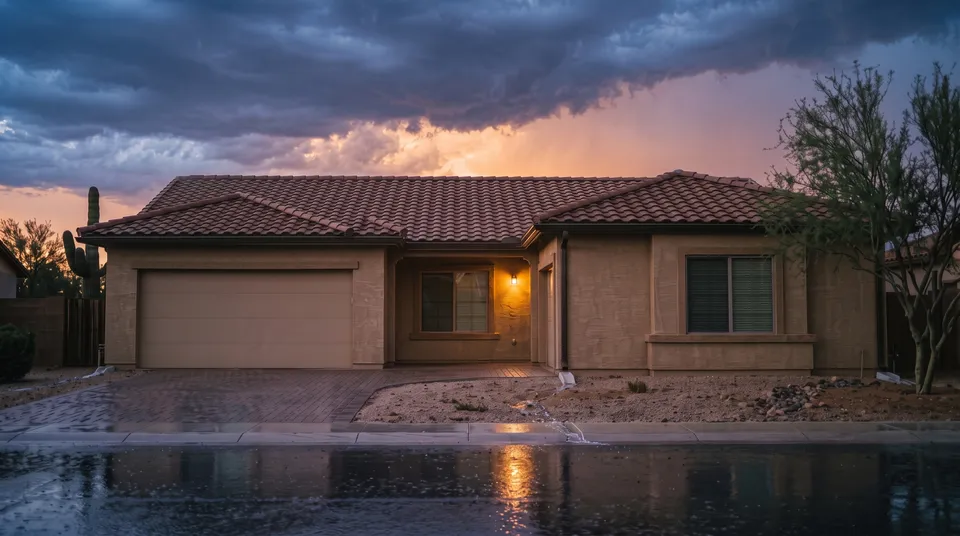
The short answer: Because nothing made the builder put them on. No Phoenix or Maricopa County code requires gutters on a single-family home, annual rainfall is low, tile roofs with wide eaves throw water clear of the wall, and the lot was graded to carry it away. Those assumptions hold until you add a patio, pavers or planters under the eave.
Why doesn’t my house have gutters?
Walk any street in Deer Valley or Anthem and count the houses with a gutter along the fascia. On a block built in the late 1990s or 2000s it will be a minority, and the ones that have them were almost all added by an owner later. That is not neglect. It is the outcome of five decisions that the builder, the code and the climate made together.
1. No code requires them
This is the one people get wrong, and we want to state it plainly: there is no building code in Phoenix, in Maricopa County, or at the state level that requires gutters on a single-family house. Older posts (including one that used to live on this site) implied that homes were built “before gutters were required.” They were not required then and they are not required now. The residential code does address drainage, but it does it through grading: the finished ground has to slope away from the foundation so surface water leaves. A builder meets that requirement with a grading plan, and the inspector signs off on the grade, never on a gutter.
2. The annual rainfall number
Phoenix gets roughly seven inches of rain in a normal year. In a wet climate that is a slow month. A builder pricing a subdivision looks at that number and sees a line item with no payoff. What the annual total hides is the delivery schedule: a large share of it arrives between June 15 and September 30 in storms that can put an inch on a roof in under an hour. Gutters are sized for the rate, not the total, and the rate here is severe.
3. Tile roofs with wide eaves
Most Valley production homes have concrete S-tile roofs with eaves that often overhang the wall by 18 to 24 inches. The tile profile throws water outward off the eave, so on a bare lot the drip line lands well clear of the stem wall. Compared to a shingle roof with a 12-inch eave in a wetter state, the tile roof genuinely does a better job of keeping the water off the wall on its own. That is a real advantage, and it is part of why builders here felt they could skip the gutter.
4. The gravel yard assumption
The grading plan assumes the ground under the eave stays the way the builder left it: bare decomposed granite, sloped away from the house, draining to the side yard and out to the street. On the day of the final walkthrough, that is what it looks like. Water off the roof hits gravel, sheets across it and leaves.
5. Cost across a subdivision
Leaving gutters off one house saves a modest amount. Leaving them off four hundred houses is a line item worth protecting. Production builders in the Valley have treated gutters as an owner upgrade for decades, in the same category as a patio cover or a water softener loop. On a custom home in Anthem Country Club or a semi-custom in a North Scottsdale enclave you will more often find them from the start, because the buyer specified them.
The HOA angle
Some master-planned communities discouraged visible gutters early on for the sake of a clean roofline. Most now allow them, with rules about color: matched to the fascia or the stucco field, never a contrasting accent. Our four standard colors (dark gray, bronze, white and tan) cover almost every Valley fascia and stucco palette we run into, and we can tell you before the estimate which one your HOA will approve.
Why the builder’s grading stops working
Everything in the five reasons above depends on the yard staying as delivered. Here is what happens to a typical backyard in the first five years.
The owner pours a patio slab or lays a paver patio off the back door, and now the drip line lands on hardscape that was set level, or worse, pitched slightly toward the house because the yard fell that way. A planter bed goes in along the back wall with a curb around it, and the curb traps water against the stucco. Decomposed granite compacts, silt from haboobs fills the voids, and the surface that used to drain now sheds water sideways instead. A side yard gets a gate, a shed and a trash-can pad, and the swale that was supposed to carry water to the street is blocked.
The house did not change. The ground under the eaves did, and the grading plan that was standing in for gutters no longer exists.
What that looks like after a few monsoons
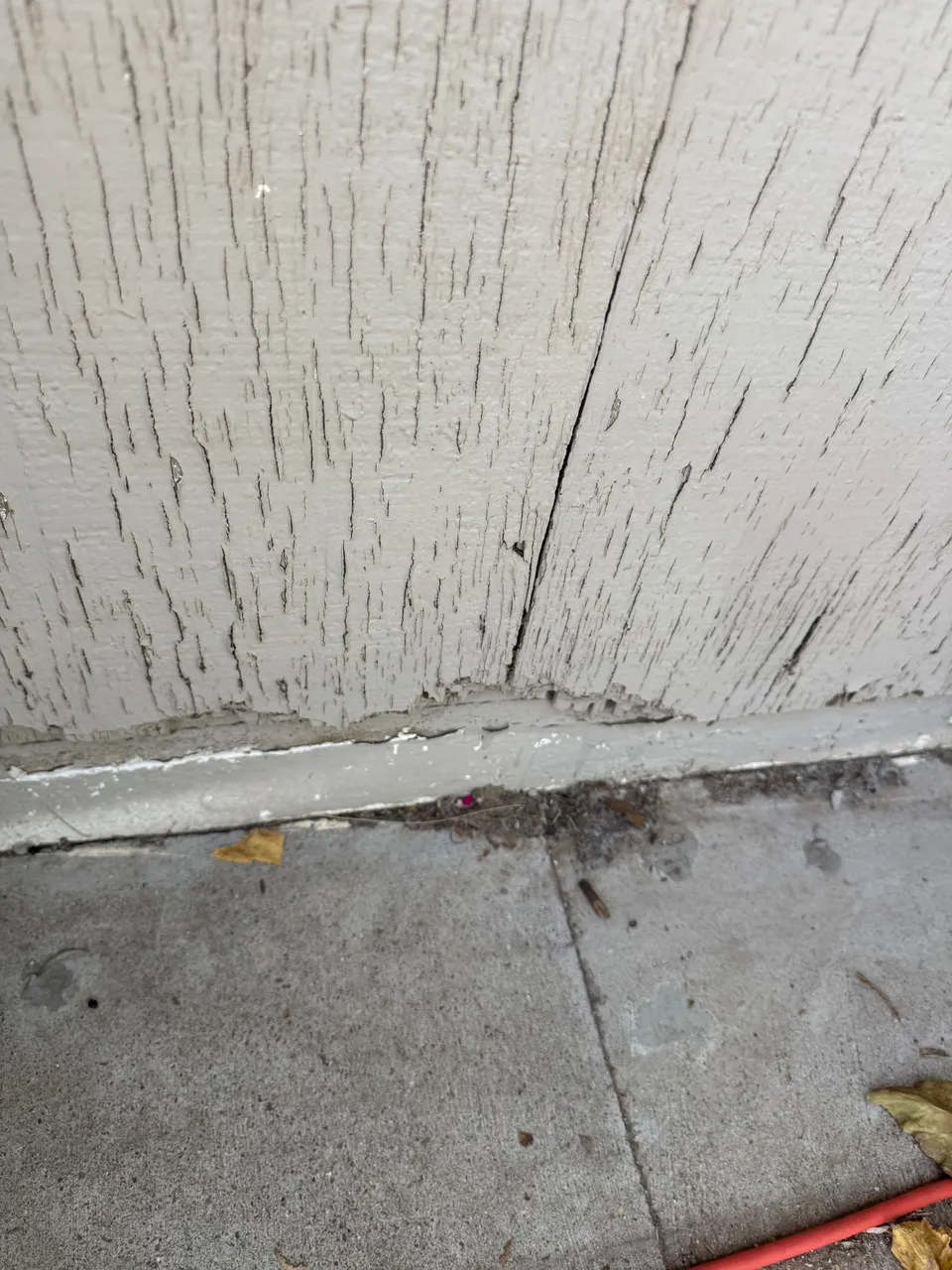
You can read it on the house. A row of small craters in the decomposed granite under each tile trough. A brown band on the stucco a foot above grade where the roof grit splashed up. Pavers along the back wall sitting lower than the rest of the patio. A puddle at the garage threshold after every storm. Silt lines on the cool deck. We have a longer walk-through of the sequence in can a house survive without gutters in Arizona.
Should you add them now
Not necessarily to the whole house. The eaves that drain onto a door, a patio, a walkway, a planter or a stem wall are the ones that need a gutter and a downspout routed somewhere better. A bare eave over a concrete apron that slopes away can stay bare.
A common first job on a house like this is two runs rather than the whole perimeter: the rear eave over the patio, with a downspout carried to the side yard, and the eave over the front entry so you can reach the door in a storm without walking under the drip line. That covers most of what owners actually complain about, and the rest of the house can be added later if the side yards turn out to need it. Timing matters too. Monsoon runs June 15 to September 30, so a run that goes on in May protects the yard through the whole season, and one that goes on in August has already missed half of it.
When we do add a run, it is 6-inch seamless aluminum, formed on site to the length of the eave, hung from the fascia below the tile with the downspouts placed so the discharge lands where you want it. Six-inch carries more water than 5-inch and catches the overshoot off an S-tile eave. Most jobs are done in a day. The seamless gutter installation page covers what goes into it.
If you want to know which of your eaves are the problem, we do free estimates and will tell you which ones to gutter and which to leave alone.
Want us to look at your house?
Free written estimate, measured in person. Most installs finish in a single day.
Questions we get asked
Why do new builds not have gutters?
A production builder is not required to install them, and on a subdivision of several hundred homes leaving them off is a real saving. The lot is graded to drain to the street or a rear swale instead. The builder's grading plan assumes bare decomposed granite under the eaves, which is rarely how the yard stays.
Does Arizona building code require gutters?
Not on most single-family homes. The residential code requires the lot to be graded so water drains away from the foundation, and gutters are one way to meet that, not the only way. Builders satisfy it with slope and decomposed granite instead. Some cities and HOAs add their own rules, so check before assuming either way.
Did my builder offer gutters as an upgrade?
Often, yes, as a design-center option most buyers skipped because the base model looked fine and the monsoon was months away. Some builders add gutters only where the plan puts a door under an eave. If your house has gutters on the front and none on the back, that is usually the reason.
Will my HOA let me add gutters?
Almost always, as long as the color matches the fascia or the stucco field. Most master-planned communities treat gutters as an exterior change that goes through design review, so submit the color sample first. We supply the chip, and the approval is usually the only step that adds time to the job.