By Grant Lee · September 10, 2026 · Gutter Installation
Can a House Survive Without Gutters in Arizona?
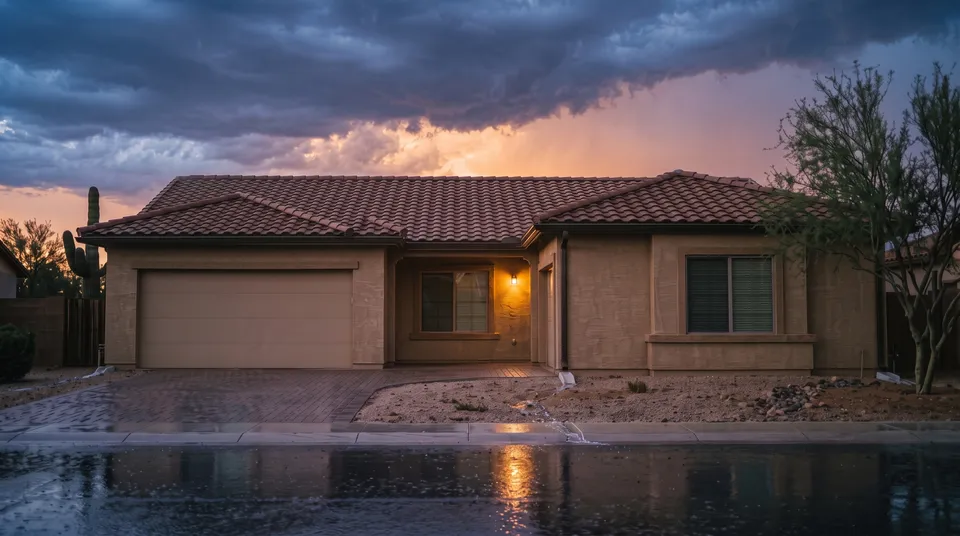
The short answer: Yes. A Phoenix house will stand for decades without gutters. What it will not do is stay dry at the base of its walls: every monsoon storm drops a roof's worth of water into a narrow strip of soil against the foundation, and the damage builds one season at a time.
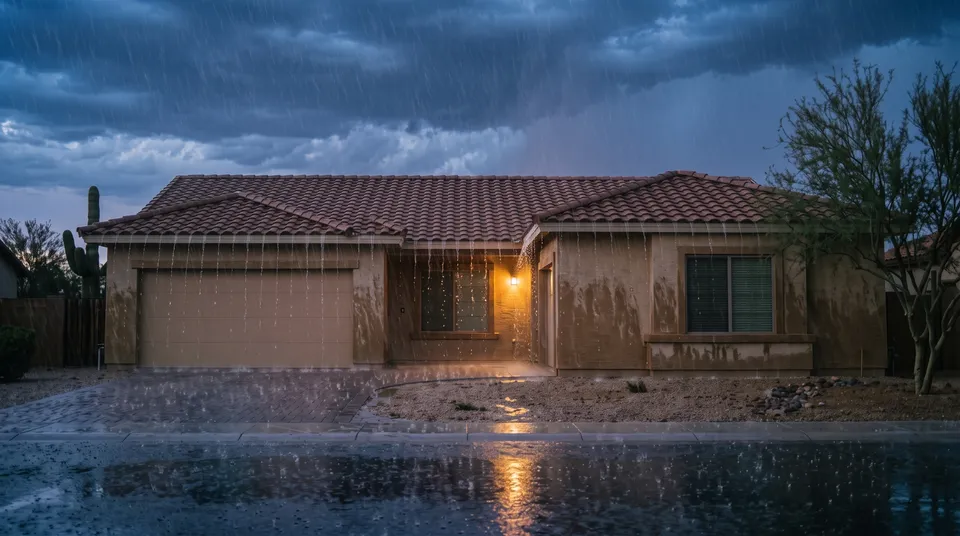
Can a house survive without gutters in Arizona?
Structurally, yes. Gutters are not part of the house’s frame or its roof system. A house with bare eaves keeps standing, keeps its roof, and keeps the rain out of the living space as well as the house next door with a bronze gutter run along the fascia.
What gutters change is where the water lands. A roof is a collector. Every square foot of it takes the rain that falls on it and delivers it to the eave, and without a gutter the eave delivers it straight down to a strip of ground about a foot or two out from the wall. That strip is where the trouble lives. It is where the stem wall meets the soil, where the stucco ends, where the walkway pavers start, and where the front door threshold sits.
So the fair way to read “survive” is this: the house survives, the ground under the eave takes the hit, and over enough seasons the ground passes some of that back to the house.
Do Arizona homes need gutters?
Most of them, yes, and the reason is the shape of the rain rather than the amount. (If you are wondering why yours came without them, why your house has no gutters covers the builder economics.) Phoenix does not get much water in a year. It gets most of it in a handful of storms between June 15 and September 30, and those storms are short, hard and concentrated. A strong monsoon cell can put an inch of rain on your roof in well under an hour.
The math on that inch is worth knowing. One inch of rain on one square foot of roof is 0.623 gallons. On a 2,000 square foot roof that is 1,246 gallons, delivered to the eaves in the time it takes to eat dinner. Without gutters, every one of those gallons lands in the drip-line strip.
Three local conditions make that worse than it would be somewhere with gentler rain.
The ground does not take it. Much of the Valley sits on caliche, a hardpan layer of cemented calcium carbonate that can be inches or feet thick and is close to waterproof. Above it, most yards are decomposed granite or gravel over compacted fill. Water that hits that surface at monsoon rate does not soak in. It sheets. It runs across the gravel to the lowest point, and on a lot graded flat near the house, the lowest point is often the foundation.
The roof concentrates it. Most Phoenix homes have concrete S-tile roofs. The tile profile channels water into the low troughs between each pan, so it leaves the eave as a row of separate streams rather than a curtain. Each stream hits the same spot every storm. That is why you see a line of small craters in the decomposed granite under a tile eave and a smooth trench under a shingle eave.
The dust arrives first. By the time the first monsoon storm hits, a roof has been collecting dust since spring. The first inch of rain carries that grit off the roof and onto whatever is below. On stucco it dries as a brown splash band. On a cool-deck patio it leaves a tide line.
None of this means a house in North Phoenix needs a gutter on every eave. It means the eaves that drain onto something that matters, which is nearly every house, need one.
Where the water lands on a Phoenix house
Walk the perimeter of a typical Valley single-story and the picture is consistent from house to house.
The front entry usually sits under an eave or a small gable, so the walk to the door crosses the drip line. The garage eave drains onto the driveway apron, which is fine if the apron falls to the street and a puddle at the threshold if it does not. The rear eave is the longest run on a hip roof and it drains onto the patio, which is where most of the complaints start. The side yards catch the two shorter eaves, and on a lot with a paver walkway along the house, those pavers sit right under the drip line. Inside corners, where two roof planes meet in a valley, dump a single heavy stream that carves the deepest crater of all.
Every one of those spots is a place where “survive” and “undamaged” part ways.
How long can a house go without gutters?
There is no honest number of years, and we are wary of anyone who gives you one. The pace depends on three things: how much roof drains to a given eave, what sits under the drip line, and which way the ground slopes when the water gets there.
What we can give you is the order the damage shows up in, so you can read your own house after a storm.
Season one to three: the ground
The first thing to go is the surface under the eave. Decomposed granite migrates. A trench forms along the drip line, deeper under the tile troughs. Gravel washes onto the sidewalk and into the street. Desert plants in the splash zone either drown at the roots or get their crowns buried in silt.
The next few seasons: the walls and hardscape
Stucco stops at a weep screed a few inches above grade, and that bottom band is the splash zone. It picks up a brown mud line first, then a white mineral bloom as the water wicks up and dries, then the paint lifts and the finish coat starts to flake. At the same time, any paver walkway or patio slab that starts within the drip line begins to settle at the edge nearest the house, because the bedding sand under it is being washed out one storm at a time.
Over many wet-dry cycles: the slab
This is the slow one. Soil at the perimeter of the house gets soaked every storm and baked dry between storms, while the soil under the middle of the slab stays at roughly the same moisture all year. On clay soils that means the edge swells and shrinks and the middle does not. The slab does not crack through; it tilts at the edge, and the tilt shows up inside as diagonal cracks off the corners of door and window openings and doors that stop latching in August. We cover the mechanism in how monsoon storms damage Phoenix foundations.
A house with a concrete apron under the entire drip line, graded away from the house, can sit at stage one for a long time. A house with a paver patio and a planter bed against the back wall can reach stage two in a couple of summers.
What happens if you never install gutters?
The stages above keep cycling. Nothing resets between seasons. The trench gets deeper, the stain band gets wider, the pavers keep dropping, and the perimeter soil keeps moving. On most houses you end up paying for one of the downstream repairs, sometimes two, without ever having addressed the water that caused them.
There are also the day-to-day costs that never make a list. The front door you cannot get through during a storm without stepping under a waterfall. The garage slab that gets a puddle at the threshold every time. The patio you cannot use for an hour after rain because the sheet flow left an inch of standing water on it. The window sills under a second-story eave that stain every year.
And there is the maintenance you inherit. Every trench gets refilled with new decomposed granite. Every stain band gets pressure-washed and repainted. Every sunken paver course gets lifted and re-set. Those are recurring jobs, and every one of them is treating a symptom.
What the fix looks like
A gutter run does one thing: it catches the water at the eave and moves it to a downspout, and the downspout puts it where you choose. On most Phoenix homes the choice is a side yard that drains to the street, a gravel bed away from the house, or a splash block with an extension that carries the discharge four to six feet past the foundation.
Our standard is 6-inch seamless aluminum, formed on site from coil to the exact length of each eave so there are no joints along the run to open up. Six-inch carries more water than 5-inch and catches the overshoot off an S-tile eave better. It comes in four colors (dark gray, bronze, white and tan) so it can match fascia or stucco, which matters in master-planned communities like Anthem where the HOA has an opinion. Most installations are done in a day. The seamless gutter installation page covers what goes into the job and what moves the price.
When a house genuinely does not need them
We would rather tell you this than sell you a run you do not need.
A flat foam roof with parapets drains through scuppers, and if those scuppers already discharge to open ground that slopes away from the house, a gutter has nothing to add. A house where the entire drip line lands on a concrete driveway or apron that falls away from the wall is in the same position. And a house that is about to be reroofed or get a patio cover should wait, because the gutter goes on after the roof edge is finished, and doing it twice helps nobody.
Everywhere else, the eaves that drain onto a door, a patio, a walkway, a planter bed or a stem wall are the ones to protect. It does not have to be the whole house. A partial run over the back patio and the front entry is a legitimate answer for a lot of homes, and are gutters worth it on a Phoenix house walks through how we decide.
If you want a second set of eyes on where your roof is putting its water, we do free estimates and will tell you which eaves need a gutter and which can stay bare.
Want us to look at your house?
Free written estimate, measured in person. Most installs finish in a single day.
Questions we get asked
Do I need gutters in Arizona?
Most Phoenix houses benefit from them, and the reason is the monsoon rather than annual rainfall. A single storm can put an inch of rain on the roof in under an hour, and without gutters all of it lands within two feet of the foundation. Houses with hardscape, planters or doors under the eave need them most.
Is it bad for a house to not have gutters?
It is not dangerous in the short term, and plenty of Valley homes have gone years without them. The cost shows up slowly: a trench under the drip line, mud and mineral stains on the stucco, pavers that drop next to the wall, and soil at the perimeter that swells and shrinks with every storm and dry spell.
What happens to a house with no gutters?
Roof water lands in the same strip of ground every storm. First the decomposed granite washes out and a trench forms under the eave. Then the bottom foot of stucco stains and starts to peel. Pavers and patio slabs near the wall settle, and over many wet-dry cycles the soil movement can reach the slab edge.
How long can a house go without gutters?
There is no fixed number of years. It depends on how much roof drains to each eave, what sits under the drip line, and how the lot was graded. Some houses show a trench and stucco staining after two or three monsoon seasons; a house with deep eaves over a concrete apron that slopes away can go far longer.
What to use instead of gutters on a house?
The honest alternatives are a concrete or paver apron graded away from the house under the whole drip line, a French drain or gravel trench at the drip line, or rain chains where a full run is not wanted. Each one manages water after it hits the ground; gutters are the only option that keeps it off the ground.