By Grant Lee · September 10, 2026 · Gutter Installation
How Monsoon Storms Damage Phoenix Foundations
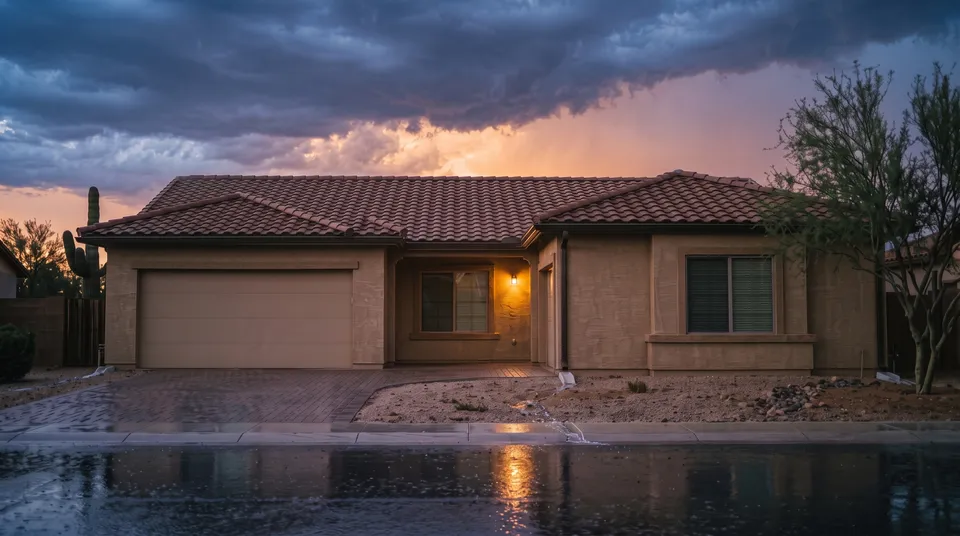
In short: A monsoon storm puts a roof's worth of water into the two feet of soil against the foundation, then the sun bakes it dry. On the clay under much of the Valley that soil swells and shrinks with every cycle, and the edge of the slab moves while the middle stays put. That differential movement is what shows up inside as cracks off the corners of doors and windows.
How monsoon storms damage Phoenix foundations
The chain has four links. Understanding them is worth the two minutes, because it tells you which fixes matter and which are cosmetic.
1. The storm puts the water in one place
Between June 15 and September 30 the Valley gets a handful of storms that can drop an inch of rain in under an hour. One inch on a 2,000 square foot roof is 1,246 gallons (0.623 gallons per square foot per inch). On a house with no gutters, all of it leaves the roof at the eaves and lands in a strip of ground a foot or two out from the wall. A concrete S-tile roof makes the strip narrower still, because the tile profile channels the water into a row of streams that hit the same points every storm.
The rest of the yard gets an inch. The two feet against the house get the roof.
2. The ground holds it against the wall
Most Valley yards are decomposed granite over compacted fill, and under much of the metro there is a layer of caliche, a cemented hardpan that is close to waterproof. Water at monsoon rate does not soak down through that. It sheets across the surface toward the lowest point and pools, or it gets into the loose backfill beside the stem wall, which was never compacted like the pad under the slab, and sits there.
Then it dries. A week of July sun pulls the moisture back out, and the soil at the perimeter goes from saturated to bone dry while the soil under the middle of the slab, which never got wet, stays the same.
3. Clay moves when it does that
Parts of the East Valley and West Valley sit on expansive clay, and clay changes volume with moisture. Wet, it swells. Dry, it shrinks. The soil under the middle of the slab does neither, because its moisture barely changes. The soil under the edge does both, every storm, all summer. The edge of the slab rides up and down on it, and the middle does not.
That is differential movement, and it is the thing that cracks houses. Uniform movement, the whole slab rising or settling together, does very little. An edge that moves while the center stays put racks the framing above it.
4. The post-tension slab tilts rather than cracks
Many Valley homes built from the 1990s on sit on a post-tension slab: a concrete plate with steel cables inside it that were tensioned after the pour, so the slab acts as one stiff unit. Post-tension slabs were adopted here in large part because of expansive soil. They resist cracking through the middle very well.
What they do instead is move as a plate. When the perimeter soil swells, the edge of the slab lifts and the plate tilts. When it shrinks, the edge drops. The slab stays in one piece, and the movement is transferred to the walls sitting on it. That is why the damage on a Phoenix house with a bare eave shows up in the drywall, the tile grout and the door frames rather than as a crack across the garage floor.
What it looks like from outside
You can read the whole chain from the yard.
Under the eave there is a trench in the decomposed granite, with a row of deeper craters under the tile troughs. The bottom foot of stucco, above the weep screed where the stucco ends a few inches off the ground, carries a brown band from the roof grit and haboob dust that comes down with the first inch of rain. Over a few seasons the band goes white as minerals wick up and dry, then the paint lifts, then the finish coat starts to come off in flakes. In the worst spots the stucco separates from the screed and you can see the lath. A hairline crack runs up from a corner of the stem wall where the edge has moved the most, often at an inside corner where two roof planes dump into one valley.
Why do cracks keep forming in my walls and ceiling?
Because the slab is still moving. Patching a crack fixes the drywall. It does nothing to the cause, and the next monsoon opens it back up along the same line.
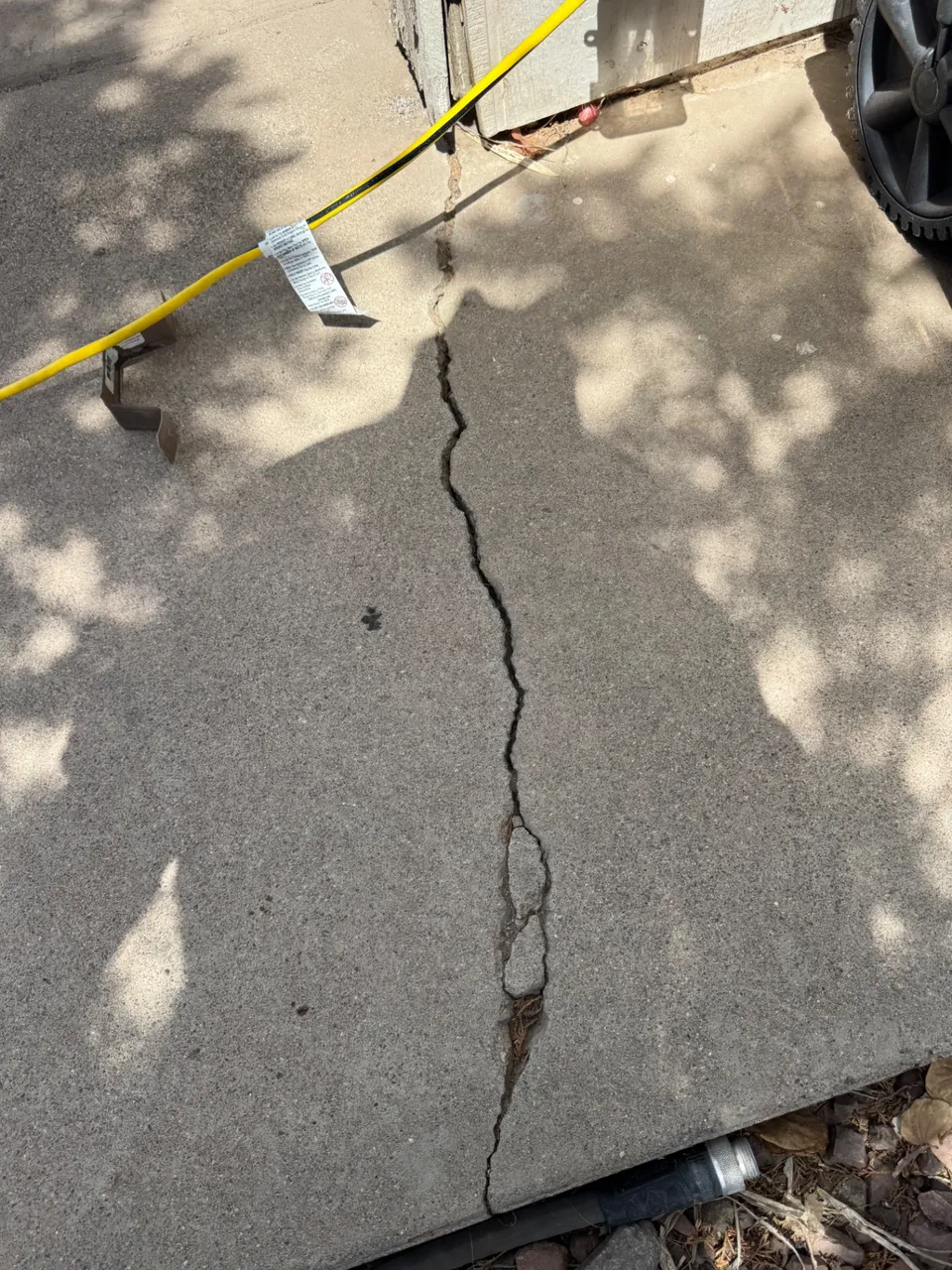
The cracks that come from perimeter soil movement have a signature. They run diagonally off the corners of door and window openings, because that is where the framing is weakest and the racking concentrates. They are worse near exterior walls than in the middle of the house. They open in late summer and may close a little in winter. Doors on exterior walls stop latching in August. Grout lines in tile floors crack in a line parallel to an outside wall.
Not every crack is this. Ceiling cracks along the wall-to-ceiling joint that open in winter and close in summer are usually truss movement in the attic, which is a framing issue and not a foundation one. A crack along a single wall with a wet spot below it is a plumbing leak. Sinking around a tree is roots. A house with irrigation heads spraying the stucco every morning has a moisture source that never turns off. Before spending money on a foundation contractor, it is worth ruling those out.
What to do, in order
Get the roof water off the perimeter. A 6-inch seamless aluminum gutter on every eave that drains onto the ground beside the house, with downspouts at the low points and inside corners. Six-inch carries more water than 5-inch and catches the overshoot off a tile eave. Our four colors cover most Valley fascia. Most houses take us a day. The seamless gutter installation page covers the details.
Put the discharge somewhere useful. Every downspout gets an extension or a splash block that carries the water four to six feet from the wall, to a side yard that drains to the street or a gravel bed that is away from the house. A downspout that lets go at the stem wall has moved the water eighteen inches.
Fix the other sources. Move drip lines off the wall. Aim sprinklers away from the stucco. Fix the hose bib.
Aim for steady moisture, not dry. The goal is a perimeter that stays roughly the same moisture year round. Bone dry is a problem too, because the soil shrinks away from the stem wall and the first storm fills the gap. Deep, infrequent watering of the beds near the house through the dry months keeps the cycle small.
Then patch. Once the water is under control, patch the drywall, re-grout the tile, and repaint the stucco. Give it a monsoon season first and see whether the cracks stay closed.
Know when to call someone else. Cracks you can fit a coin into, a door frame visibly out of square, a floor you can feel slope, or a stem wall crack that has opened over a season are past what drainage alone will fix. That is a foundation contractor’s job, and they will tell you to fix the drainage first anyway.
Where it matters most
The clay is heaviest in parts of the East Valley around Gilbert and Mesa and in stretches of the West Valley around Peoria and Surprise. The North Valley foothills, Cave Creek, Anthem and Desert Hills, run more to granite and caliche, where the same roof water trenches the ground and stains the stucco but cycles the slab less. Either way, the eave with no gutter over the two feet of soil against the house is where the water is going in, and it is the cheapest link in the chain to break.
If you would like us to walk the perimeter with you and tell you which eaves are putting water where, we do free estimates. If the pavers along the wall have already dropped, why your pavers are sinking near the house covers that piece.
Want us to look at your house?
Free written estimate, measured in person. Most installs finish in a single day.
Questions we get asked
Can monsoon rain damage a foundation?
Not in one storm. The damage comes from the cycle: soil against the stem wall soaked by roof water off a bare eave, then dried by weeks of sun. On expansive clay the soil swells and shrinks each time and the slab edge moves with it. Gutters keep the roof water out of that strip and break the cycle.
Why do cracks keep forming in my walls and ceiling?
Because the slab is still moving. Patching a crack fixes the drywall, not the cause. If the cracks run diagonally off the corners of doors and windows, come back after every monsoon, and doors stick in August, the perimeter soil is cycling wet and dry. Ceiling cracks that open in winter and close in summer are usually truss movement.
Do gutters protect the foundation?
They keep the roof's water out of the strip of soil against it, which on a house with bare eaves is the largest source of moisture. The downspouts have to discharge four to six feet from the wall or the water is back where it started. Irrigation along the house and plumbing leaks are sources gutters do not touch.
What does foundation damage look like in Arizona?
Outside: a trench under the drip line, a brown then white band on the stucco above grade, stucco peeling at the weep screed, and a hairline crack running up from a corner of the stem wall. Inside: diagonal cracks off door and window corners, doors that stop latching in summer, and cracked grout lines in tile floors near exterior walls.