By Grant Lee · September 10, 2026 · Gutter Installation
Why Are My Pavers Sinking Near the House?
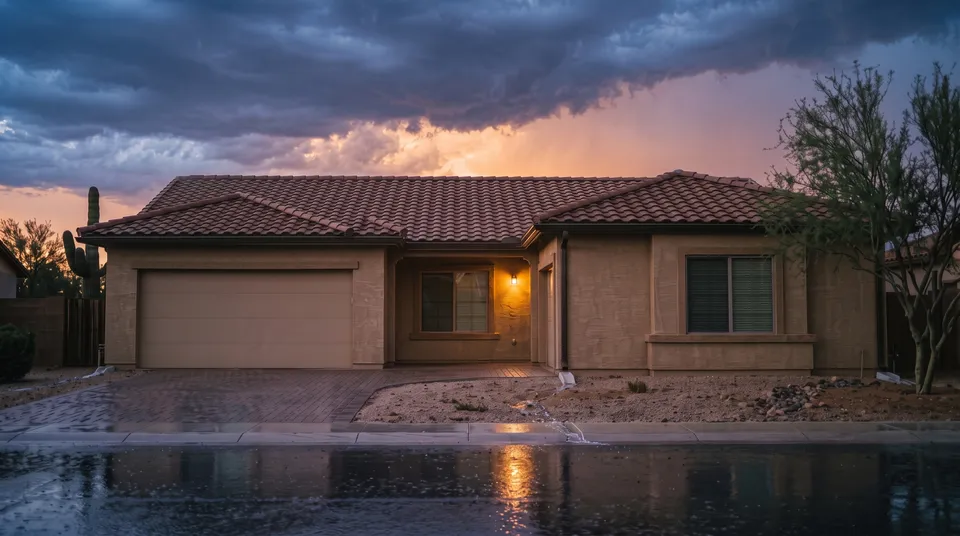
The short answer: Because the roof edge above them has no gutter. The drip line off a tile eave lands on the first two or three courses of pavers, the water finds the joints, and every storm washes a little more bedding sand out from under them. Caliche below keeps it from draining down, so it moves sideways and takes the base with it. Gutters first, then re-set the pavers.
Why are my pavers sinking near the house?
Pavers are only as stable as the inch of sand and the few inches of compacted base under them. Nothing holds a paver in place except the material beneath it and the pavers beside it. Take the sand away and the paver has nowhere to sit. That is the whole mechanism, and on a Phoenix house the sand is taken away by the roof.
Sheet flow off the eave
A concrete S-tile roof does not drip evenly along the eave. The profile channels water into the troughs between pans, so it leaves the edge as a row of separate streams, each one hitting the ground at the same point every storm. On a paver walkway that runs along the side of the house, the streams land on the first two or three courses out from the wall. A monsoon cell that puts an inch on the roof sends 0.623 gallons per square foot of roof to that eave, so a 40-foot side eave draining 500 square feet of roof is putting a little over 300 gallons on those pavers in under an hour.
Water at that rate does not sit on top of a paver. It goes straight down the joints, and the joint sand goes with it. Then it reaches the bedding sand, spreads sideways under the pavers, and carries the sand out through the lowest joint it can find. After a few storms there is a hollow under the course nearest the wall, and the paver settles into it. You can often read the sequence in the joint lines: the sand is gone from the joints nearest the wall, still present two courses out, and the low spot follows the missing sand exactly.
Caliche and the fill against the wall
Two things about the ground beside a Valley house make this faster than it would be elsewhere.
The first is caliche. Under much of the Phoenix area there is a layer of calcium carbonate hardpan, sometimes inches down, sometimes a foot or two, and it is close to waterproof. Water that gets under the paver base cannot go down through it. It goes sideways, along the top of the caliche, and it moves base material as it goes. A paver walkway on top of shallow caliche is a paver walkway on top of a drain that has no outlet.
The second is the backfill. When the stem wall was poured, the trench beside it was backfilled with whatever came out of it, and that fill was never compacted the way the pad under the slab was. The first couple of feet out from the wall is looser than the rest of the yard. Soak it every storm and it consolidates, and the pavers sitting on it drop with it. That is why the sinking is always worst right against the house and tapers off a few feet out.
Rule out the other causes first
Roof water is the usual answer, and it is worth ten minutes to confirm it is the only one, because a gutter fixes one source and any others keep working.
Drip irrigation. A drip line that runs along the house behind the pavers, or a leaking emitter at a shrub next to the walkway, wets the base every day instead of every storm. If the sinking lines up with a plant rather than an eave, look at the emitter.
A hose bib or a leaking spigot. Same idea, one spot.
No edge restraint. Pavers with nothing holding the outside edge creep outward over time and the joints open. That looks like sinking from a distance but the pavers are spreading, not dropping.
A neighbor’s yard. If the lot next door is higher and drains toward yours, water is arriving from the side. A gutter does nothing for that.
Base that was never compacted. A walkway laid on a couple of inches of loose sand over native soil will settle everywhere, not only under the eave. Even so, a bare eave above it makes the settling under the drip line worse.
If the low spots line up with the eave above them and are worst against the wall, it is the roof.
The fix, in order
1. Gutter the eave. A 6-inch seamless aluminum run on the fascia under the first course of tile, along the full length of the eave that drains onto the pavers. Six-inch is our standard because it carries more water than 5-inch and catches the overshoot off an S-tile edge. We match one of four colors (dark gray, bronze, white, tan) to the fascia. Most runs go up in a day.
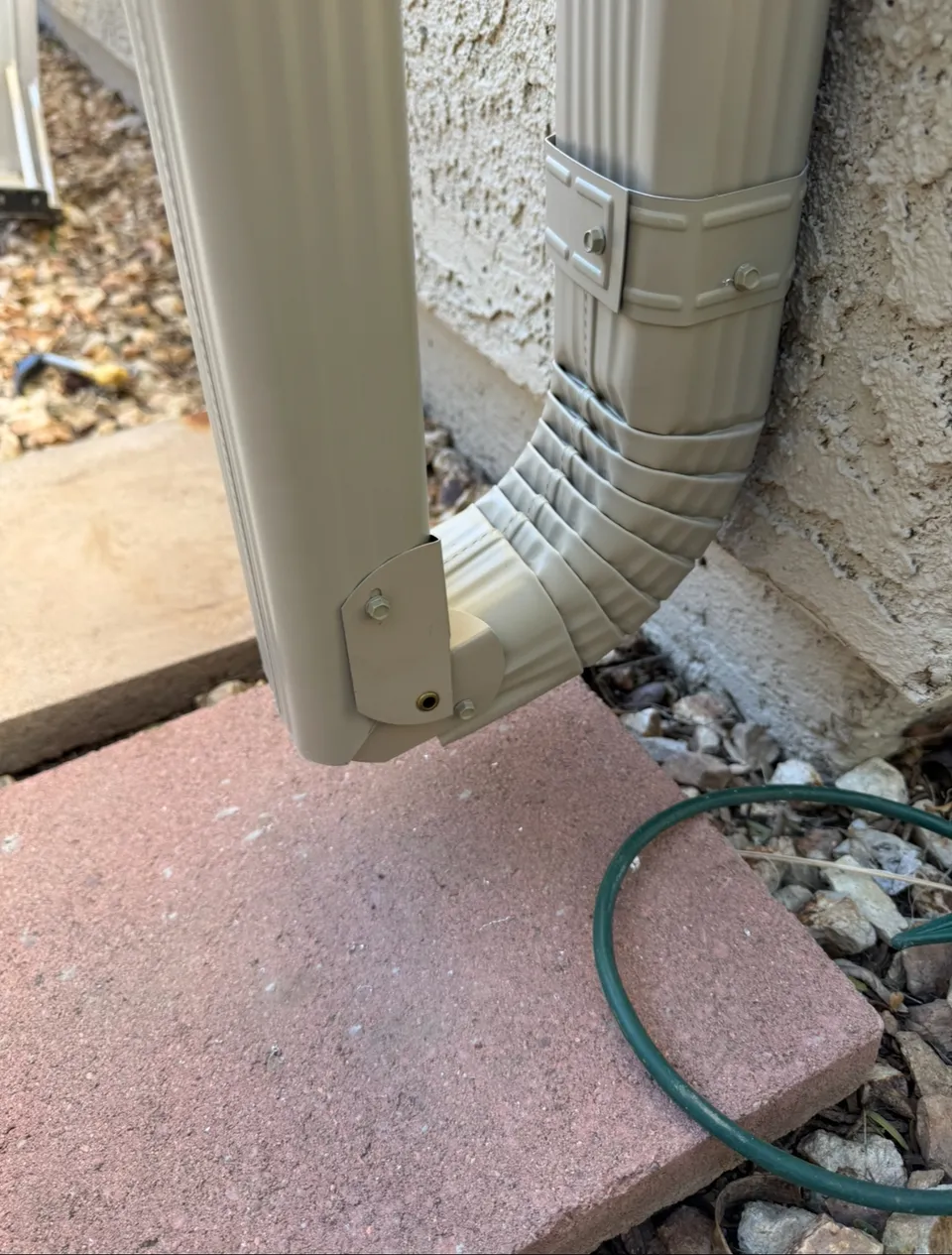
2. Downspouts and extensions. The downspout has to let go somewhere that is not the walkway. On a side-yard walkway that usually means running the downspout to the end of the run and extending the discharge four to six feet past the last paver, or across the walkway in a short buried line to a gravel bed that drains. A downspout that ends at the walkway has moved the problem, not solved it. Existing downspouts that are crushed, disconnected or dumping in the wrong place are covered under downspout and gutter repair.
3. Fix the irrigation. Move the drip line off the wall or cap the emitter that is wetting the base.
4. Now re-set the pavers. Lift the courses that have dropped, dig out the washed base, add and compact new base, screed fresh bedding sand, re-lay, and sweep in joint sand. Edge restraint along the outside course keeps the re-set pavers from spreading. With the roof water gone, the base stays where you put it.
We are a gutter company and we do steps one and two. Steps three and four are a paver contractor or a weekend. The point of the order is that four only lasts if one and two are done first.
A note on the East Valley
Homes in Gilbert and Mesa sit on some of the more clay-heavy soils in the metro, and paver patios and walkways are common there. Clay adds a second motion to the settling: it swells when it is soaked and shrinks when it dries, so a paver over clay under a bare eave both drops into a washed-out base and rides up and down with the soil through the monsoon. The gutter takes the water out of both.
If your pavers have dropped along the wall and you want to know whether the eave above them is the cause, we do free estimates and will tell you which eaves to gutter and where the downspouts should let go. The why your patio floods post covers the same water where it lands on a patio slab instead.
Want us to look at your house?
Free written estimate, measured in person. Most installs finish in a single day.
Questions we get asked
Why do pavers sink next to the house?
The drip line off a bare eave lands on the courses nearest the wall. Water gets into the joints, washes the bedding sand out, and the paver drops into the void. The soil against a Phoenix foundation is also backfill placed after the stem wall was poured, and it settles more than the yard around it when it gets soaked.
Can you fix sinking pavers without gutters?
You can lift them, add base, re-compact and re-set them, and it will look right until the next monsoon puts the same water in the same spot. If the eave above is bare, the sand washes out again. Fix the water first, then the pavers, or you will be doing the paver job every couple of summers.
Will gutters stop pavers from sinking?
They stop the roof water, which on a paver walkway under a bare eave is the cause most of the time. The downspouts have to discharge past the pavers, not onto them. If the sinking is along a drip irrigation line, at a hose bib, or where a neighbor's yard drains in, gutters will not fix that part.
Is it bad for a house to not have gutters?
Sinking pavers are one of the early signs that it is. The same water that washed out the paver base is soaking the soil against the stem wall every storm and drying it out between storms. On clay soils that wet-dry cycle moves the slab edge. Pavers show it first because they are the loosest thing in the splash zone.