By Grant Lee · September 10, 2026 · Gutter Installation
Why Does My Patio Flood When It Rains?
The short answer: Because the roof is putting a roof's worth of water on it. On most Phoenix homes the patio sits directly under the longest eave, so without a gutter every storm sheets hundreds of gallons across a slab that was poured flat. Gutters over that eave, with downspouts routed past the patio, fix the roof water; grading or a drain fixes the rest.
Why does my patio flood when it rains?
Stand on the patio during the next storm, or run a hose on the roof above it for ten minutes, and watch where the water comes from. It will be one of four places, often two of them at once.
The eave above it
This is the big one. A Phoenix back patio is almost always under the rear eave of the main roof, and on a hip-roof house that rear eave is the longest run on the building. Every square foot of roof that slopes toward the back wall drains to it. One inch of rain on 1,000 square feet of that rear slope is 623 gallons (0.623 gallons per square foot per inch), delivered to the patio edge in the time a monsoon cell takes to pass.
Concrete S-tile makes it worse in a specific way. The tile profile channels water into the troughs between pans, so it leaves the eave as a row of streams, each one landing in the same spot every storm. On a cool-deck patio you can see the row of clean circles where they hit; on a paver patio you can see the joints washed out under each one.
The patio cover
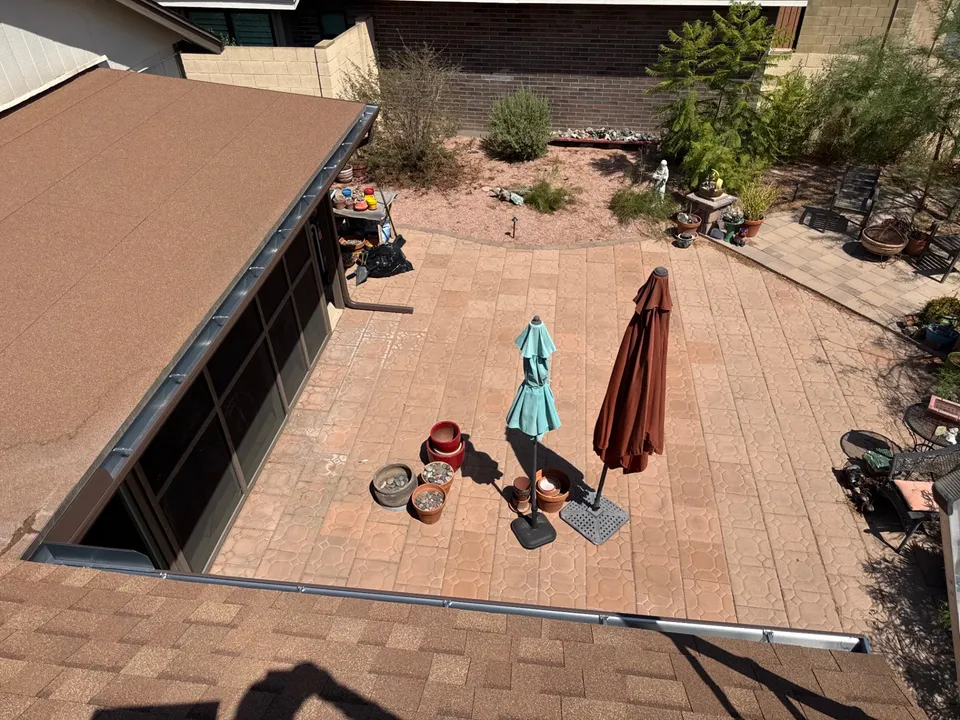
Most aluminum patio covers in the Valley have a gutter built into the front beam. That gutter collects the cover’s own roof and dumps it at one corner, through a small outlet or a short downspout, and that corner is usually at the patio edge, right where you walk out into the yard. Some covers are attached under the main eave, so the main roof drains onto the cover and the cover drains onto the patio. Where the cover meets the house is often the single worst spot on the whole patio.
The slab itself
Patio slabs get poured level because level is easy to finish and looks right. A level slab drains nowhere. On a lot where the yard falls toward the house, which is more common than it should be on older Valley subdivisions, the slab was set to match the yard and drains toward the door. Paver patios have a different failure: the bedding sand under the first two courses nearest the wall washes out under the drip line, the pavers there settle, and the low spot they leave is the puddle.
The yard
Some patio water never touched the roof. It came across the yard from a higher neighbor, or from a side yard whose swale to the street has been blocked by a gate post, a shed pad or a trash-can slab. That water arrives at the patio from the side and has nowhere to leave. A quick way to tell: yard water shows up before the roof has had time to shed much, and it keeps coming after the rain stops.
The order to fix it in
We do this in a sequence for a reason: each step removes a source, and the next step gets easier to diagnose once the bigger source is gone.
1. Gutter the eaves that drain onto the patio. Usually the rear eave, sometimes an inside corner where a side wing meets the back wall and two roof planes drain into one valley. We hang 6-inch seamless aluminum on the fascia under the first course of tile and put a downspout at each end of the run and at every inside corner. Six-inch matters here because the S-tile eave throws water out past the fascia, and the wider trough catches the overshoot.
2. Route the downspouts past the patio. A downspout that lets go at the patio edge has moved the problem three feet. We run the discharge along the wall to the side yard, or across the patio in a short buried line, and let it go where the yard actually drains, four to six feet past the slab at minimum.
3. Deal with the cover. If the cover has its own gutter, we make sure its outlet is not dumping onto the patio, and tie it into a downspout where we can. If the main roof drains onto the cover, the gutter goes on the main eave above it.
4. Then, and only then, look at the slab. With the roof water gone, whatever still pools is a slab or yard problem. A channel drain along the back wall, a thin overlay to re-pitch the slab, or lifting and re-setting the pavers nearest the wall are the usual answers. Doing this before the gutter means you re-set pavers that the next storm washes out again.
5. Check the side yard. Walk it. If the swale to the street is blocked, clear it. If the neighbor’s lot drains into yours, that is a grading conversation, and no gutter fixes it.
When gutters solve it and when they do not
Gutters solve the roof share, and on a house with a bare rear eave the roof share is most of it. If the patio floods only during rain and dries out quickly after, and the water is worst along the wall, that is roof water and a gutter run will end it. If it floods in a light rain that barely wets the roof, look at the yard first.
Gutters do not fix a slab pitched toward the house. They do not fix a yard that sends water in from the side. And they do not fix a downspout that discharges right next to the slab it was supposed to protect. We see all three, and we would rather point you to the right fix than sell you a run that solves half the problem.
Two Valley details worth knowing
The first is dust. From the end of the last monsoon in September until the first storm the next June, the roof collects a season of haboob silt and roof grit. The first inch of rain washes all of it off, and on a patio with no gutter it dries as a brown tide line along the wall and in every low spot. A gutter carries that first flush to the downspout instead.
The second is timing. Monsoon runs June 15 to September 30. The patio that floods every August should have its gutter on before the middle of June, and most runs take us a day. We work across Scottsdale, Surprise, Peoria and the rest of the North Valley, and the seamless gutter installation page covers what goes into the job. If your pavers have already started to settle along the wall, why your pavers are sinking near the house is the next read.
If you want us to look at where your patio water is actually coming from, we do free estimates and will tell you which of the five steps your house needs.
Want us to look at your house?
Free written estimate, measured in person. Most installs finish in a single day.
Questions we get asked
Do gutters help with patio flooding?
They fix the largest share of it. On a typical backyard the patio sits under the main rear eave, and that eave delivers most of the roof's water onto the slab. A 6-inch seamless gutter on that eave, with downspouts routed to the side yard, carries that water away. Yard runoff and a mis-pitched slab need their own fix.
How do I stop water from pooling on my patio?
Start at the roof: gutter the eaves that drain onto the patio and route the downspouts past it. Then look at the slab. If it was poured level or pitched toward the house, a channel drain along the wall or an overlay to re-pitch it will move what lands there. Last, check that the side yard drains to the street.
Why does my covered patio still flood?
Look at the cover's front beam. Many aluminum patio covers in the Valley have a built-in gutter along that beam that empties at one corner, and that corner is often at the patio edge. Water also blows in under the cover, and the main roof above the cover dumps onto it where the two meet. Guttering that junction solves it.
Can gutters prevent water from pooling around my house?
They prevent roof water from pooling there, which on a house with no gutters is most of it. Each downspout has to discharge somewhere that drains, four to six feet from the wall, or the water is back where it started. Surface water from a neighbor's lot or a blocked side-yard swale is a grading job, not a gutter job.